A sample text widget
Etiam pulvinar consectetur dolor sed malesuada. Ut convallis
euismod dolor nec pretium. Nunc ut tristique massa.
Nam sodales mi vitae dolor ullamcorper et vulputate enim accumsan.
Morbi orci magna, tincidunt vitae molestie nec, molestie at mi. Nulla nulla lorem,
suscipit in posuere in, interdum non magna.
|
By júlia verdaguer, on març 21st, 2011% Today, March 21st, is World Poetry Day.
So here are some ideas related to poetry that you can use in the classroom:
– Pick a poem that you liked as a child and read it to your students. Discuss the meaning of words and see how words rhyme even though they are spelled differently (rhyme/mime, rain/Jane…)
– Write a poem with the students! Give them a random word, easy to rhyme, like “air”, and help them find rhyming words: bear, care, chair, compare, there, square… Then, in small groups, help them make up a poem using these words.
– Shape poetry! Pick an object, for example a tree, and ask your students for words that can describe it: green, tall, leafy, strong, small, colorful, old… Using these words, write a short poem along with the students, and have them write it in the shape of the tree. Click here to see an example (extracted from this site)
 (Click on image to see it bigger) (Click on image to see it bigger)
By júlia verdaguer, on març 9th, 2011%  This is the first post of a series aimed to give both Conversation Assistants and their tutors some resources where they can get ideas on what the Assistant can do in the classroom. This is the first post of a series aimed to give both Conversation Assistants and their tutors some resources where they can get ideas on what the Assistant can do in the classroom.
One interesting source is the BBC and British Council website TeachingEnglish. There you will find teaching and training materials, activities and ideas for your teaching; as well as a forum to discuss exchange ideas and share materials.
First of all, you can visit the great Language Assistant section. With lots of ideas, activities and games for all ages and levels, and tricks and tips to be a great Conversation Assistant!
If you need even more ideas:
- Ideas for many activities to practice speaking, vocabulary or pronunciation, amongst others, submitted by other teachers.
- In the section “Lesson Planning“, you will find a range of topics to discuss with students of different levels.
- If you want to use texts and literature, there is a lot of material in BritLit. It is divided in three levels: Primary Level, Sencondary and Younger teens.
- Finally, if you are working with young children, don’t forget to take a look at Teaching Kids: a whole section dedicated to people who teach English to children! There are lots of activities to do with the kids and also lots of material that you can use both online or printed in the classroom.
Stay tuned for more ideas and links!
The PAC team
By júlia verdaguer, on març 8th, 2011%  Gràcies a aquesta proposta del Projecte Escola Multilingüe de la Fundació Escola Cristiana de Catalunya, les escoles que així ho sol.liciteu podreu disposar d’un o més estudiants anglesos, seleccionats per Home To Home, per a qui l’anglès és llengua materna perquè duguin a terme tasques d’assistència en totes les vostres activitats d’ensenyament-aprenentatge de l’anglès, 25 hores a la setmana, de dilluns a divendres, d’octubre a juny. Gràcies a aquesta proposta del Projecte Escola Multilingüe de la Fundació Escola Cristiana de Catalunya, les escoles que així ho sol.liciteu podreu disposar d’un o més estudiants anglesos, seleccionats per Home To Home, per a qui l’anglès és llengua materna perquè duguin a terme tasques d’assistència en totes les vostres activitats d’ensenyament-aprenentatge de l’anglès, 25 hores a la setmana, de dilluns a divendres, d’octubre a juny.
Un auxiliar de conversa pot col.laborar en les vostres activitats AICLE essent present a l’aula amb el professor, pot donar un cop de mà en treballs de grup, per parelles, preparació d’exposicions orals; pot augmentar la incidència en la llengua oral a través de petits diàlegs, jocs de taula, petites lectures; pot col.laborar en l’elaboració de materials, pot enregistrar textos, pot participar en les activitats musicals, teatrals, esportives… i pot estimular la competència comunicativa només amb la seva presència activa.
El vostre compromís consisteix en proporcionar a l’Auxiliar de Conversa allotjament i manutenció gratuïts en l’àmbit d’una família (o més d’una, fins a un màxim de tres) vinculada amb l’escola, designar un tutor responsable de l’Auxiliar en el vostre centre, i satisfer una quantitat mensual per Auxiliar de Conversa.
Per sol·licitar un o més auxiliars de conversa, heu d’emplenar el full de sol·licitud, que podeu descarregar aquí. Podeu consultar el Conveni de Cooperació en aquest enllaç. També podeu descarregar-vos la Guia per a les famílies acollidores. Tots aquests documents els trobareu a la pàgina “Information on the Program” dins d’aquest bloc.
Per qualsevol dubte o consulta, podeu adreçar-vos a pac@escolacristiana.org
Animeu-vos a sol.licitar-ho, i feu-ho abans del 31 de maig, que és la data límit!
By júlia verdaguer, on febrer 16th, 2011% Carla is a Conversation Assitant at Escola Regina Carmeli in Horta. She’s having a great time here and learning a lot about teaching English!
………………………………………………………………………………………………………………………….
Hi, i´m Carla and i´m currently living in Horta, barcelona and working at Escola Regina Carmeli. After completing my TEFL course finding this job was the perfect opportunity to get my teaching and travelling experience started and what an exciting city to begin in!
When I arrived in Sepetember I didn´t really know what to expect but my nerves soon disappeared as I was given a warm welcome by the school and my first family. My first day at school I was thrown right in at the deep end, teaching both primary and secondary children with varying levels of English. Having the opportunity to teach all ages and learning levels has taught me so much about teaching in the few months that I have been here. It is real hands on experience, every day is different and the kids and teachers are fantastic!
I get to go on a lot of school trips and this has allowed me to see parts of the city and the surrounding areas that I may not have otherwise ventured to.
Living with families who have kids at the school is an excellent way to settle straight into Barcelona life and is a great way to learn the language and about different cultures. I move families every six weeks, which is possibly a little too often because once I have unpacked and settled in and got to know the family and their routines, I have to move. The positive aspect of moving is that I have been able to see and do a huge variety of activities and I have met so many new people!
The language barrier was at first daunting but I understand more and more evey day. Living and working in the country is the best way to learn a new language. The children, teachers and families help me with my Spanish and I help them with their English.
I would recommend this experience to everyone! I am having a great year!
By júlia verdaguer, on febrer 10th, 2011% Chelsea Church and her tutor at Escola Vedruna, in Girona, wrote to us about their impressions on the CAP’s programme. Joan’s entry is in Catalan; he writes about how happy they are with Chelsea and how her presence in the school is making the students’ level of English improve…and also the teachers’!
We thank you both for your entries!
………………………………………………………………………………………………………………………….
JOAN BOIX, tutor de CHELSEA CHURCH de l’Escola Vedruna de Griona
Abans de res , jo voldria agrair a la Direcció de la nostra escola i a la seva Titular en particular per l’esforç de participar en aquest interessant programa dissenyat per Home to Home i l’Escola Cristiana .
La primera impressió que vaig tenir en conèixer la nostra auxiliar va ser molt positiva. A vegades diuen que les primeres impressions valen més que moltes paraules, explicacions i informes que et puguin donar.
Des d’un primer moment va entendre el què volíem d’ella i va ser fàcil explicar-li com funcionàvem i com ens agradaria que ella funcionés. Sempre s’ha mostrat molt receptiva i amb moltes ganes d’aprendre. La seva integració ha estat més fàcil del que ens esperàvem. Des del primer dia va tenir un molt bon tracte amb nosaltres i amb els alumnes. Ha après ràpid a fer de “mestra” i que els alumnes la respectessin.
Les seves qualitats humanes, la seva senzillesa i les seves ganes de fer ben feta la feina fa que ens sentim a la nostra escola força afortunats.
Creiem que ha après ràpid els nostres costums i va entenent de mica en mica la nostra manera de ser. Evidentment hi ha moltes diferències de costums i sociològiques entre el seu país i el nostre. El nostre desig, i el meu en particular, és que ens entengui com a poble i que la seva estada aquí entre nosaltres sigui recordada amb alegria a més d’una experiència personal altament profitosa.
Pels alumnes és una gran millora i una gran ajuda pel seu aprenentatge. Però per tots els mestres que parlem anglès, també. Amb ella estem millorant dia a dia el nostre nivell, tant de vocabulari com de listening com de fluidesa. Tot això haurà d’afectar en millorar la nostra qualitat de l’ensenyament de la llengua anglesa, tant de forma directa com indirecta.
L’experiència està essent molt positiva. Tots estem molt contents. Només volem desitjar que continuï així i que tots junts seguim fent un profitós camí.

CHELSEA CHURCH, auxiliar de conversa de l’Escola Vedruna de Girona
My first impressions of the Vedruna school were very good: a beautiful, old building set right in the heart of Girona. The children are all very friendly and are not afraid to introduce themselves or ask you questions which made me feel welcome. There is the constant buzz of Catalan conversation as you walk around the school grounds, which is at first disconcerting when your mother tongue is English and nothing makes sense. I quickly became enveloped in the Catalan language as the teachers too converse it, obviously as it is the regional language of Catalunya. This is a small difficulty for me as I had come to Girona on the pretence of learning Castillian and my internet-based lessons are on the Castillian language. I would definitely find it easier to learn Castillian if living in a different Spanish region or even Barcelona, where there are more Castillian speakers.
None the less, some teachers make an effort to speak Castillian infront of me and I have made friends who speak stronger Castillian. Most of my lessons are ´Science in English¨ with the sole aim to improve the students English vocabulary and speaking skills. I enjoy these lessons very much and there are alot of opportunities for communicating with the children and preparing activities.
I also speak English with students in the older classes such as ESO and Baxcillerate, both have a higher level of English than the primary students so lessons mainly consist of conversation about a range of topics. I also teach extra english classes twice a week in my lunch time which is very stressful in controlling the classes but rewarding when their English actually improves. I have been assigned a pastor in the school which is very good as if I have any problems I know who to go to, such as organising a bank account. I am also introducing him to English humour and, although he is slow to catch on, he is eager to learn!
There are vast differences in culture between England and Spain; firstly alot of activites occur at a later time such as dinner between half past nine to ten o´clock. In England I am used to eating dinner at seven o´clock, and my host family eat at half past eight which is viewed as early, but they have two young children. School finishes at half past five and then there are extra curricular acitivites, which account for the late dinners. At first these extra hours exhausted me but my body clock has finally adjusted!
The Mediterrean diet is much more healthy than typical British food; it involves alot of tomatoes, olive oil, fish and fruit. I love the food here, especially Pa amb Tomata which is bread covered in olive oil and tomatoes. One lapse in this healthy diet is the popular Churros, a typical Catalan deep fried pastry. Definitely an annual treat as I can feel my arteries hardening when Churros is consumed. Another typical Spanish dish is the Spanish omelette- a thick, potato affair which can be made with as many as 16 eggs! However the usual number is 5 eggs. It is also typical for people to drink wine with their lunch which is a tradition not experienced by people in England.
Catalan people are much more expressive with their emotions than the stiff upper lipped Briton, so I find it easy to understand how someone is feeling due to their rapid hand movements and tone of voice. I personally prefer this open form of character, even if people have commented on me retaining a typical British front of politeness.
My host family include two young children which provides a very different home setting to my English family where nobody is under 16. Obviously this has been a crash course in coping with young children but it has aided me in my teaching methods in the school. The family cook delicious, healthy meals of an evening and we all sit together at a table which I enjoy. I am required to give some of my time to the girls of an evening in the week, in which we speak in English whilst we colour pictures or play a game. I am also required to drop them off and pick them up from a ballet class once a week as part of my contribution to the household. The family have been very kind in taking me to visit different areas of Catalunya, such as Costa Brava and Banyoles.
I have found myself missing my family and friends much more than I expected, but I assume this is because I only finished school myself in June and everything is very different to my life in England. However the kindess of people who look after me has definitely helped to stop feeling homesick!
The city of Girona has a beautiful old part, which includes an amazing Cathedral in a rustic, cobbled stone setting of narrow, winding streets. There are a few good bars and a clubs which I have frequented with new friends, and most are reasonable in price. I have made English friends on the same programme and also Spanish friends from Girona University. This weekend is a national four day holiday which celebrates the Saint of Girona. There will be a fairground, beer tents, music e.t.c. so I am very much looking forward to it. My host family are going on holiday so I am going to stay with a Spanish friend in a nearby village.
By júlia verdaguer, on febrer 7th, 2011% Amie and Sarah Jane are two Irish conversational assistants staying at Col·legi Maristes Montserrat in Lleida. Together with the Primary School English teachers they are working with, they have written telling us about their experiences in both the school and Lleida.
Thanks a lot!
………………………………………………………………………………………………………………………….
In Maristes Montserrat School from Lleida, we are having the opportunity of sharing the new experience of having two Irish girls helping us. We consider it is a very enriching experience for both the kids and the teachers.
We are learning about their culture and their living style. Apart from this, they are helping us to improve children’s fluency and comprehension throughout the lessons.
The most important thing is that children considered them as part of their lives and count on them when the kids need help. The following words are their own experience:
Amie Sullivan:
My experience has been both educational and fun. I have seen many new approaches and techniques of teaching. It has been an eye-opening experience for me to learn that there are many different, friendly and fun ways to teach and learn.
In the school we have a language lab which we call “The Yellow Submarine,” there are seven different “corners” in this classroom. I have many different roles here; from computer technician to grammar police. It’s a great way for the children to interact with English in different ways and they have the opportunity to speak with me and ask me different things as well as for help. The children during this time have the opportunity to speak in English in a normal everyday manner and often have things to tell me since the last class.
When not in the language lab we are in the classroom, at this time I take a group of about 4 children and have a conversation or do a picture description with them. It gives us the opportunity to see how the children are doing with the language as individuals and it is great to see first hand how much progress they are making.

The teachers here have been very friendly and welcoming to me, they have included me in many ways. We often spend our lunch times laughing at my attempts to speak Spanish and it’s lovely to see that the teachers always try to help each other to speak English with me. It is wonderful to see that speaking English as a normal means of communication has stretched farther than the classroom. Teachers, parents and children often stop me in the hallway to ask something or just have a conversation.
After some months here, it is easy to see that it has made a big difference having people around who speak English on a regular basis, people don’t giggle when they say “hello” now and then revert back to their own language. They spend the time trying to speak in English it isn’t just theory to easily forget now, they really need it. I expected to work in the background and only have the children speaking English during class-time but it has turned out to be very different and it makes me feel like I’m making a difference in some way.
I will miss everyone when I am finished but I will have many memories, pictures and new friends in the end.
………………………………………………………………………………………………………………………….
Sarah Jane Mc Kiernan:
My mother heard an advertisement on the local radio station about voluntary work (paid a small amount) in Spain, as an English teacher’s assistant. She took down the details and passed them on to me. At first I really didn’t know to apply for it or not. But then I relished I love working with children and also the job was in Spain so it would be a great experience the learn there culture and to pick up on some Spanish.
So I finally sent my C.V to the company Home to Home. I got a really fast reply back asking when it would suit me to have an interview and of course my reply was as soon as possible that would suit you. My interview went really well. During the whole interview I felt comfortable and relaxed. Julie (the interviewer) asked me if there was a certain area in Spain I would like to work but my reply was just ´no I would be happy anywhere. She told me I would know if I got the job or not by an email in no more than 3days.
A few days later I checked my emails and there it was an email telling me I got accepted for the job. I was delighted.
I have been here in Maristes Montserrat, Lleida since September but it feels like I have always been here and I would be happy to stay here forever. As soon as I walked in the doors of the school I felt myself and happy. All the teachers are so friendly and so positive all the time and I really think that it helps me to work well when I am around so many nice people.

I start work at 9am and finish at 5:30pm but everyday feels like a half day. Time really does fly by here. I assist one of the English teachers with pronunciation, comprehension, sentences structure, conversation pieces and a few other things.
As I said before the name of the company I am with is called Home to Home and it really has been that for me.
By júlia verdaguer, on febrer 1st, 2011% Lauren is a Conversational Assitant at Col·legi Sant Jordi de Palafrugell. She and her tutors Marta and Eva have written a really nice e-mail to us, explaining what Lauren does at the school to improve the students’ English and how she’s adapting to living in Catalonia.
They have also included many photographs and the instructions to a game they play with Primary school classes: Repeat and Do! It’s game that you can play with your students to help them learn vocabulary in a fun and easy way.
Thank you, Marta, Eva and Lauren!
………………………………………………………………………………………………………………………….
¡Hola!
My name is Lauren and I am a conversation assistant at Collegi Sant Jordi in Palafrugell, Catalunya. I live with a local family, who have welcomed me into their home and treat me like one of their own children – they have really helped me to settle in. At home, I speak mainly Spanish, but I also help the children with their English. My ´Catalan sister´ lived in America for a year, so she speaks English very well and helps me a lot with my Spanish. I had learnt some Spanish before I arrived, which helped me to get to know my family – and I´m now trying to learn some Catalan.

In school, I work with children from Infantil P-3 (aged 3) to 4t ESO (aged 16). Obviously, this means that the activities I do in school are very varied. With the Infantil classes, I read stories in English and ask simple questions about the characters, for example “What colour is the elephant?” to give the children the chance to practice vocabulary and to encourage them to speak. We use puppets, flashcards and songs to make the classes fun and engaging. With the primary classes, I work with smaller groups (10-15 children) and we sing songs and play English games, for example, ´Listen, Repeat and Do´. We also practice short dialogues and conversations around the themes that the children are learning in class. With the secondary classes the activities are quite varied and often the pupils will research and prepare their own topics to discuss. They like to find out about the culture and trends in England. In all of the classes, I have explained the traditions of Halloween, Bonfire Night and Christmas – and the secondary classes enjoyed making pumpkins and Guys and taking them to show the younger children. Everyone in school has helped me to settle in, inviting me to social events in and out of school and helping me with any problems or worries.

This is one of the games we play with the primary school classes:
How to learn 80 actions in a fun way from 1st to 4th Primary
Learning vocabulary is a good way to start a foreign language, not the only way but one of the most important ones.
But, how to learn vocabulary in a useful and comprehensive way?
With our “auxiliar de conversa” Lauren, we have put into practice the activity we are going to tell to you.
We have chosen 20 actions for each course.
In 1st course the actions are related to sports and movement.
Here´s the list:
JUMP – RUN – WALK – DANCE – HOP – SKIP – FLY – SWIM – CATCH THE BALL – KICK THE BALL – TURN AROUND – STAMP YOUR FEET – CLAP YOUR HANDS – TOUCH YOUR HEAD – SKATE – STAND UP – SIT DOWN –NOD YOUR HEAD – WHISTLE –

In 2nd. Course the actions are related to the house.
GO TO BED – SLEEP – DREAM – WAKE UP – STRECHT – GET UP – HAVE A SHOWER – BRUSH YOUR TEETH – WASH YOUR HANDS –
HAVE BREAKFAST – GO TO SCHOOL – HAVE LUNCH – HAVE DINNER – WATCH TV – KISS YOUR GRANDPA – HUG YOUR MUM –
FEED THE CAT – PAT THE DOG – WATER THE PLANTS – PHONE YOUR FRIENDS –
In 3rd. Course the actions are related to school.
DO THE HOMEWORK – READ A BOOK – WRITE – LISTEN TO THE TEACHER – SAY THANK YOU – DRAW A PICTURE – COLOUR THE PICTURE – CUT OUT THE PICTURE – STICK THE PICTURE ON THE WALL – DO AN EXERCISE – CORRECT THE EXERCISE – PLAY THE FLUTE – SING A SONG – SPELL “ruler” – USE THE MOUSE –TIDY UP YOUR DESK – PUT YOUR THINGS AWAY – PUT ON YOUR ANORAK – TAKE OFF YOUR JACKET – OPEN THE DOOR –
In 4th. Course the actions are related to hobbies and free time.
DANCE – PLAY FOOTBALL – RIDE A HORSE – RIDE A BIKE – PLAY BASKETBALL – INVITE YOUR FRIENDS – VISIT YOUR GRANDMA-
DECORATE YOUR BEDROOM – MAKE A CAKE – DO A JIGSAW – MOVE YOUR BODY – PLAY ON THE COMPUTER – DANCE TO FUNKY MUSIC – DIVE – PLAY BOARD GAMES – PLAY THE GUITAR – PLAY THE DRUMS – LISTEN TO MUSIC – SCORE A GOAL –
WRITE AN E-MAIL –
The way we do this:
The teacher has a list with all the actions. Every day he teaches a new one. First he says the action and at the same time he does it, then he says the action again, the children repeat it and finally they mime it. Every day a new action is added and all the other actions that they have learned before are repeated.
By júlia verdaguer, on gener 28th, 2011% Ashleigh Hough is a Conversational Assistant at Escola Pia Terrassa. She works with both Primary and Secondary classes, from 10 to 16 years old. For her, CAP’s has turned out to be a big challenge but also a great opportunity to learn about new methods of teaching and to get to know a different culture.
Thank you for your e-mail and photos, Ashleigh!
………………………………………………………………………………………………………………………….
Since the end of September, I have been working as a Conversation Assistant in Escola Pia in Terrassa, a city forty minutes from Barcelona. I work with children between the ages of 10 and 16. I am helping to prepare the Primary school children for the speaking section of their English exam, and I am helping to give the Secondary school children an opportunity to speak English and to hear a native English accent through a range of activities. I knew basic Spanish before arriving here, but it was a shock at the beginning to find that everybody speaks Catalan in the centre of Terrassa – the classes in my school are all taught in Catalan and the teachers all speak Catalan in the staff room and at lunchtime. The little Spanish that I knew suddenly felt useless, but as the weeks and months have passed, it has become easier to hear the similarities between Catalan and Spanish. Furthermore, I am sure that by the end of the nine month programme I will have learnt a lot more Spanish and some Catalan! Besides, everybody here is capable of speaking fluent Spanish as well, so whenever I want to practice my Spanish or require help with my Spanish homework, there are plenty of people willing to help me.

Me playing ‘Quinto’ (Bingo) with the children in Primària
The school days here are long – mine run from 9am–5.30pm but a lot of the children begin at 8am on some days. We begin the ‘afternoon’ classes at 3.20pm … the children could not believe it when I told them that in England we finish school at this time! I have spare hours in my day to use the computer facilities, to plan the speaking activities and of course to visit cafés with friends! At the beginning the whole experience was a little overwhelming and sometimes lonely, but now I have many friends and I am rarely stuck for something to do. The teachers and the pupils are really friendly with me and they like to practice their English. I get invited to go on school trips … in April, for example, I am going on a school trip to England! My first family was great and now after three months I have moved in with my second family. In April I am due to move in with the third. Living in a different ‘home’ each term means that I improve my knowledge of the city and get to meet more people, and by living with Catalan families I am learning how true Catalan people live.

Me teaching a special Christmas class
I would recommend this programme to anyone who wants to learn about their own capabilities, a new culture, the methods of teaching, and to someone is ready for a challenge. I am certainly enjoying myself and I am already contemplating the possibility of continuing to live out here after my time with Escola Pia finishes at the end of June.
Ashleigh Hough
By júlia verdaguer, on gener 20th, 2011% Luke Brennan, converstional assistant at Col·legi Sant Vicenç, and his tutor Maite, wrote us this great e-mail about Luke’s experience in the school, what he does with the kids and how his presence is helping improve everyone’s English! Col·legi Sant Vicenç is a primary school, so reading this can help other schools get new ideas about what their conversational assistant can do in English lessons with kids from 3 to 11 years old.
Thank you, Luke and Maite!
………………………………………………………………………………………………………………………….
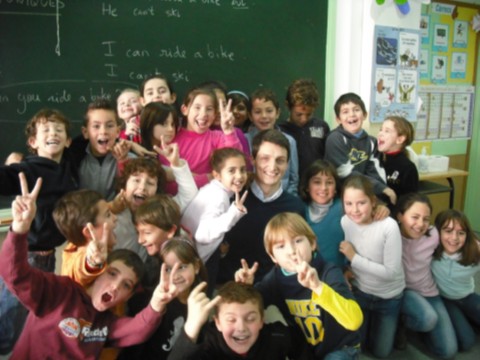
Luke Brennan, conversacional assistant at Col•legi Sant Vicenç in Sant Vicenç del Horts, is writing about his experience in the school and with his host family and how his spanish is improving day by day.
All the teachers and the students in the school feel very happy with Luke because he’s helping us in the English language classroom. The students are so motivated to speak with him in English. Some of them are making an effort to improve their english.
We all think this is a great experience for all of us!!
¡Hola!
My name is Luke; I’m working as a Conversation Assistant in Col.legi Sant Vicenç, in the town of Sant Vicenç dels Horts, just outside Barcelona.
I arrived in Barcelona 8 November 2010, and I was met by the family with which I’d be staying and the tutor from my assigned school, Maite. I was greeted with the traditional kiss on each cheek, and was immediately made feel welcome, before being taken back to the house.
I have basically been adopted into the family as one of their own, and they have been incredibly hospitable and friendly. It is a little strange when you first start living with a new family, especially when you speak no Spanish or Catalan, which was the case with me when I first arrived. The family speak varying levels of English though, and this has aided communication greatly. Meanwhile, I’ve been learning Spanish, and the odd word in Catalan, and it’s getting easier and easier to talk with the family and with various other people that I’ve met. I’m still somewhat shy about using Spanish, and so, mostly resort to English when talking to the teachers in school, but I’m trying to use a little Spanish with them now too. The experience really does improve as time goes by.
As for the actual work in the school, it has been very rewarding. Col.legi Sant Vicenç is a primary school, and I work with children from as young as 3 up to 11. The children were exceedingly enthusiastic when I first arrived, and the enthusiasm has yet to lapse much. The levels of English differ drastically between the different years, but they are all willing to try and are eager to learn, which is good for me. It is definitely easier to work with the older children though, as they understand that bit more and it allows from more varied activities.
The activities that I do and my level of involvement in the class depends on the age of the students. With the youngest students, those in P-3, P-4 and P-5, I mostly just read them an English children’s story, such as Little Red Riding Hood, The Three Little Pigs, etc. In other classes, I assist the teachers with activities and games, and help the students with their exercises and with pronunciation. The children also like ot try help me with my Spanish, which is always welcome.
However, the main work that I do is with the older students, in 5th and 6th class. With these classes I take small groups of 4 or 5 aside for conversation practice. For these groups I usaully have an exercise or game to do with the students, which provides a good for the conversation practice. The students are usually very enthusiastic, and have a near ceaseless supply of questions about my likes and dislikes, so it’s rarely quiet in these groups.

The other teachers have all been very friendly towards me, and they have been very helpful, especially my tutor, who gives me many ideas for things to do with the students, and supplies me with the exercises and activities I use in the conversation groups. With such support, this experience has never proven too difficult. It really has been a very rewarding time so far, and I look forward to the coming months.
Luke Brennan
By júlia verdaguer, on gener 14th, 2011% Karina Burrell, Conversational Assistant at Col·legi Claver from Lleida, has written to share her experience and feelings in Spain and in the school so far. We thank her and her tutor Blanca for the e-mail and the photographs they’ve sent along with it!
………………………………………………………………………………………………………………………….
My name is Karina Burrell; I work as a Conversation Assistant at a school called Claver. I first arrived in Barcelona on Sunday 26th September, this is where I met my family. I didn’t know what to expect as I all was given were small details about the family. I would say I was I feeling apprehensive and nervous but the family were very welcoming and friendly and probably felt the same as me.
My host family have two small children, which I am not used to, as I am the youngest in my family. The children always keep you on your feet and they have a lot of energy. They are willing to share details of their day or include you in the games they are playing. At some points, we have been hand in hand walking to places, I couldn’t believe how comfortable and trusting they are with someone they have only known for a few months.

My first day at school I didn’t know what to expect as I don’t speak Spanish and I thought this could be a possible barrier. However, when been introduced to the teachers and staff of the school, many of them didn’t speak English or just knew the basics, but they made the effort to speak as much as possible in English as they could. This made me feel more at ease on my first day at school. This has continued throughout the weeks I have been at school, but now I am trying to speak Spanish back to them.
My role in the school is to assist in classes that are using or been taught English. Within the school, I don’t have a precise class I work with, I work in many classes such as library, math’s and sport, within different ages ranging from 3 to 12 years old. I am enjoying this because I never know what to expect from class to class and with the different age groups too. Also, as I want to be a teacher in a few years, this is helping me to decide what age group I want to work with. Another point is I am experiencing different teachers and their teaching styles and how they compare to each other.

I have started Spanish course online and the school has been very accommodating, as they have let me sit in on Spanish classes. I get to sit in on classes listening to the pronunciation of the words and join in activities where it is possible. One thing I am starting to get used to is meal times because here lunch is a big meal and their main meal for the day. While dinner is sometimes just a snack and late at night too, they have snack time at the time I would normally have my dinner in England. In a short space of time I have tried new and different types of food: from fish to bread to soup… some I have liked and some I haven’t, but this is part of the experience.
|
|
 (Click on image to see it bigger)